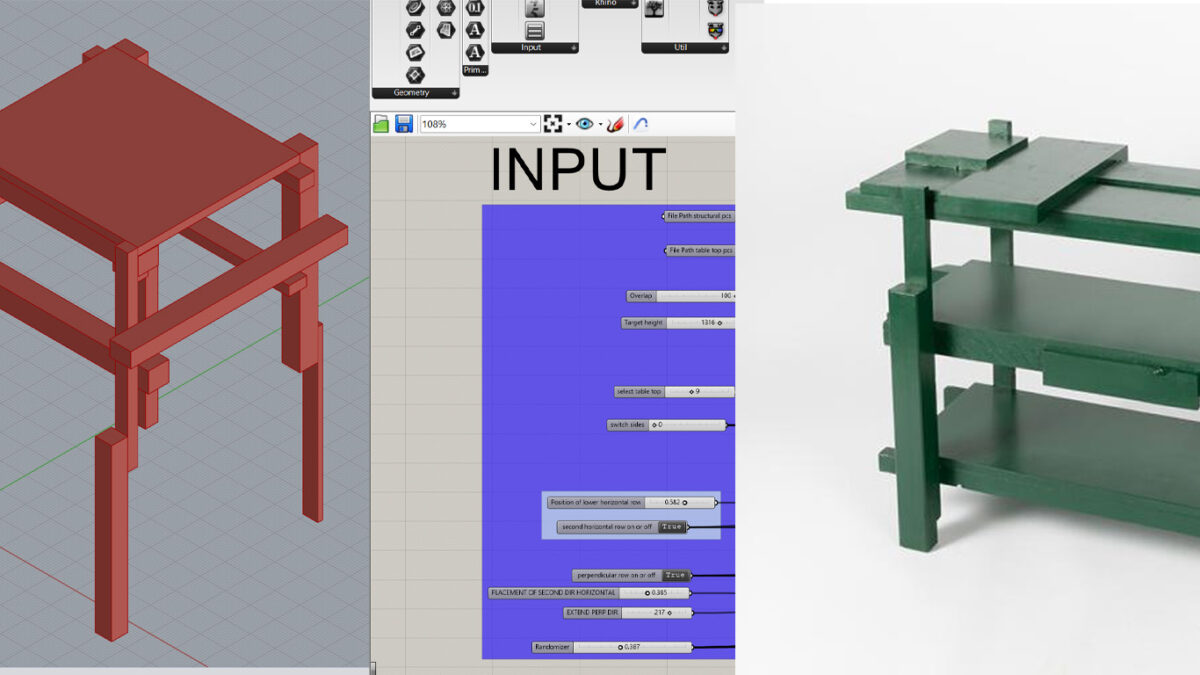
Most parametric design workflows start with a clear intention: you know what you want to build, and parameters help you optimize the design.
This project turned that logic upside down.
Designer Nico Vischi started with the opposite problem: a collection of irregular scrap materials and the challenge of assembling them into functional furniture — without cutting, modifying, or wasting any of the existing pieces.
The question was not simply “What is the optimal design?” but rather:
“Which combinations of the available pieces can satisfy the design constraints?”
From constraints to solutions
The system takes a target width and height — determined by the tabletop and a user-defined slider — together with a database of available scrap pieces with varying and irregular dimensions.
The algorithm then searches for valid combinations of these pieces that can achieve the required dimensions.
This turns the design process into a constraint-satisfaction problem at scale. Instead of manually trying combinations, the computational system can generate and evaluate a large number of possible assemblies.
Once the possible solutions have been generated, they can be ranked according to additional criteria such as stability, aesthetics, material efficiency, or simplicity of assembly.
StudioFG helped Nico Vischi develop this algorithmic engine and translate the computational logic into a practical design tool.
Some of the interesting challenges
Several aspects of the project were particularly interesting from a computational-design perspective:
- Combining pieces into longer elements
Finding sensible combinations of irregular pieces that can work together as structural or functional parts. - Tracking material usage
Keeping track of which individual scrap pieces have already been used, so that each solution represents a physically possible assembly. - Generating production drawings
Automatically turning the selected solution into production drawings, including automatically generated labels that identify each individual piece.
The result is a workflow where the available material is not treated as a limitation to design around, but as the input for the design process itself.
Rather than starting with a predefined object and searching for materials that fit it, the algorithm starts with what already exists and discovers what can be made from it.
Project links
More information about the subsidy and project:
Stimuleringsfonds — Make the best you can with what you find
More about Nico Vischi:
nicovischi.com
The project displayed at Dutch Design Week 2026:
Dutch Design Week — Make the best you can with what you have